



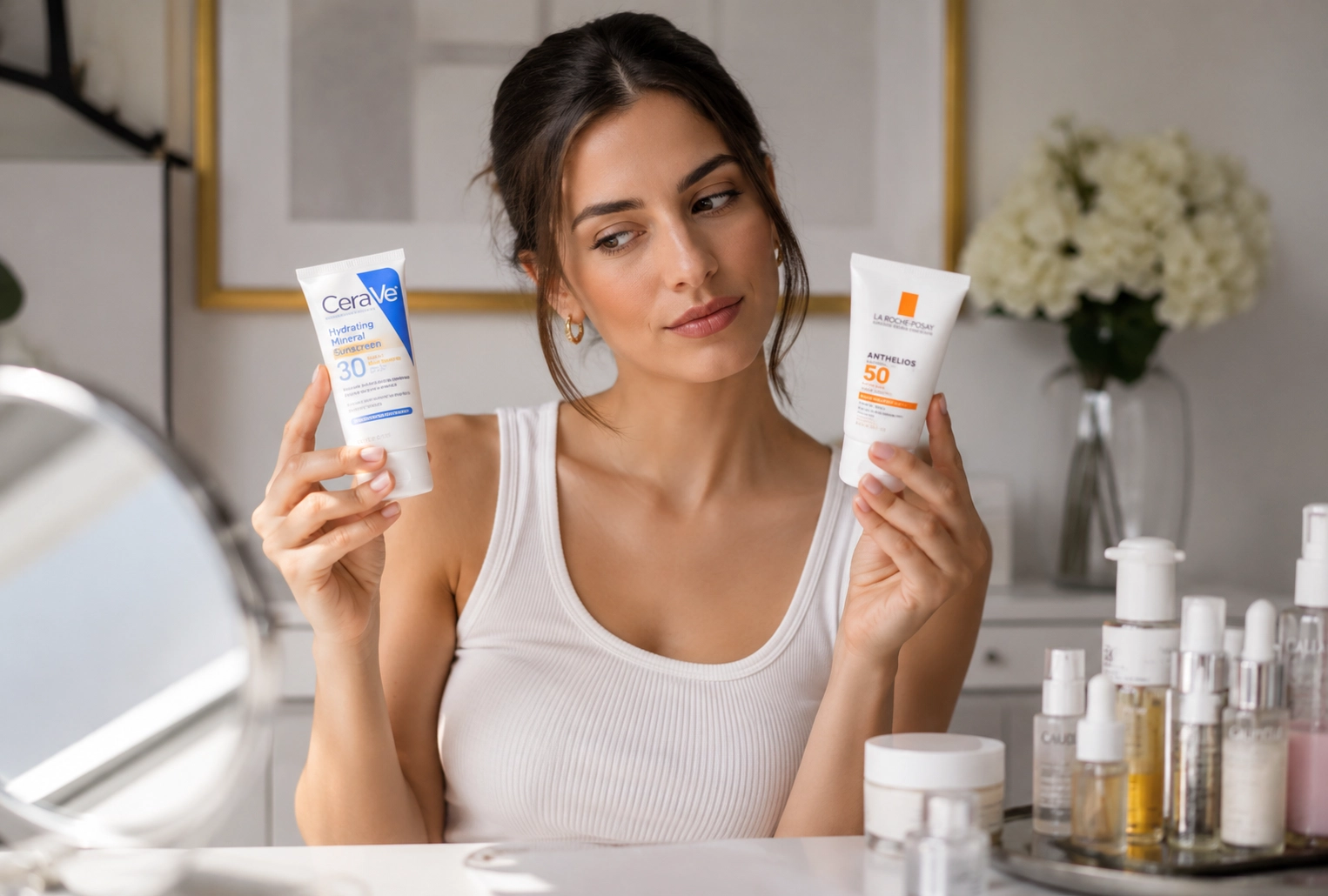
A $12 CeraVe sunscreen and a $55 ISDIN sunscreen both promise SPF 50 protection, so what are you really paying for? That’s the question behind this drugstore sunscreen vs high end sunscreen comparison. The answer isn’t what most people expect. We compared both categories across six real world factors, including UV protection, texture, ingredients, wear, and overall performance. The results reveal a much clearer picture than an ingredient list or premium price tag ever could.
Quick Verdict
- For your face and neck: A premium sunscreen can be worth it if you prefer a more elegant texture, advanced UV filters, or better makeup compatibility. But a well formulated drugstore sunscreen can also provide excellent daily protection.
- For your body and arms: Save your money. A drugstore SPF 30+ can provide excellent protection when applied generously and reapplied as directed..
- The smartest move: Use both. Spend where it counts, save where it does not.
What We Compared
We didn’t just rely on the labels. We compared drugstore and high end sunscreens using six key criteria that matter in everyday use:
- Broad spectrum coverage: UVA and UVB protection, plus the PA rating where available.
- White cast test: How noticeable the sunscreen looks on medium to deep skin tones.
- Makeup compatibility: Pilling, separation, and finish under foundation after four hours.
- Skin feel over time: Greasiness, residue, and overall comfort after a full day of wear.
- Reapplication ease: How practical and affordable it is to reapply sunscreen every two hours.
- Price per use: The real cost per application, not just the price on the bottle.
Comparison Between Drugstore VS High End Sunscreen
| Feature | Drugstore | High End |
| SPF Protection | SPF 30 to 55 | SPF 46 to 50+ |
| Broad Spectrum | Yes | Yes |
| Advanced UV Filters | Varies by formula and market | Mexoryl 400, Tinosorb S |
| White Cast | Varies by formula | Generally better |
| Under Makeup | Acceptable | Primer like finish |
| DNA Repair Ingredients | No | Some (Isdin) |
| Fragrance Free Options | Available | Available |
| Price Range | $10 to $20 | $35 to $60 |
| Reapplication Cost | Low | HighV |
Do Expensive Sunscreens Protect Better?
If your goal is basic daily sun protection, the answer is generally no. Most drugstore and high end sunscreens provide similar broad spectrum UVA and UVB protection when you apply the recommended amount. A well formulated affordable sunscreen can protect your skin just as effectively as a luxury sunscreen with the same SPF rating.
Where premium sunscreens often stand out is in their advanced UV filters. Some high end formulas use newer filters that offer broader UVA protection, including ultra long UVA rays linked to premature skin aging. These filters aren’t available in many U.S. drugstore sunscreens, so the real difference isn’t the SPF number it’s how completely the sunscreen protects against the full UV spectrum.
What You Are Actually Paying For
This is where the real value of premium sunscreens lives:
- Advanced UV filters: Premium sunscreens often use filters like Mexoryl 400, Tinosorb S, and Uvinul A Plus for broader UVA protection than most U.S. drugstore formulas.
- DNA repair technology: Some premium formulas, such as ISDIN Eryfotona Actinica, contain DNA Repairsomes with plankton derived photolyase, which ISDIN says helps repair existing UV induced skin damage.
- Makeup friendly texture: Luxury formulas from brands like ISDIN and EltaMD are designed to layer smoothly under makeup without pilling or separating.
- Dermatologist developed formulas: Products like EltaMD UV Clear combine sun protection with ingredients such as niacinamide to help reduce redness and control excess oil.
- Added skincare benefits: Premium sunscreens more often include ingredients like antioxidants, hyaluronic acid, and peptides to support overall skin health.
What you are not necessarily paying for: meaningfully better SPF numbers or longer protection windows. Every sunscreen needs reapplying every two hours regardless of price.
Where High End Wins
High end sunscreens earn their price in specific situations:
Under makeup every day: Isdin Eryfotona won the Best Under Makeup SPF award in the 2026 SPF Awards. Dermatologist Dr. Dara Spearman called out its ultra light texture that absorbs quickly without greasiness, increasing the likelihood patients actually use it consistently. Premium formulas do not pill or separate under foundation a real, practical advantage for daily wear.
Sensitive, reactive, or post procedure skin: EltaMD UV Clear was built for post procedure skin. It contains 9% transparent zinc oxide with no white cast, Niacinamide to calm redness, and zero fragrance. Dermatologists specifically recommend it after chemical peels, laser treatments, and microneedling. For rosacea prone or acne prone skin, the formula difference is genuinely meaningful.
Advanced UVA anti aging protection: La Roche Posay Anthelios UVMune 400 contains Mexoryl 400, a filter designed to protect against ultra long UVA wavelengths up to 400 nm. This makes it an interesting option for people who prioritise high UVA protection and photoaging prevention. However, the availability of similar advanced filters varies by country and product, so this should not be treated as a simple premium versus drugstore rule.
Where Drugstore Wins
Drugstore sunscreens win decisively in two areas and they are the ones that matter most for real world sun protection.
Reapplication: Every sunscreen needs to be reapplied about every two hours during sun exposure to maintain effective UV protection. Using a $55 high end sunscreen this often can become expensive, which makes many people less likely to apply enough. Affordable drugstore sunscreens make generous, regular reapplication much easier, and the best sunscreen is always the one you actually use consistently.
Body and Large Area Coverage: Covering your entire body requires about one ounce of sunscreen per application. Doing that with a premium sunscreen can quickly become costly, while a drugstore sunscreen provides the same broad spectrum SPF protection over large areas at a much lower cost. For daily body use or long days outdoors, affordable sunscreens usually offer the better value.
Common Mistakes
No matter how much you spend on sunscreen, these common mistakes can reduce its effectiveness and leave your skin with less UV protection than you expect:
- Not applying enough: applying half the sunscreen gives you roughly half the SPF. Use a full teaspoon for your face and neck alone
- Skipping reapplication: every sunscreen needs reapplying every two hours outdoors, sooner if sweating or swimming
- Using expired sunscreen: sunscreen degrades over time and in heat. Check the expiry date and store it away from direct sunlight and hot cars
- Relying on a higher SPF instead of proper application: A higher SPF does not let you stay outdoors longer without reapplying. SPF 30 or higher should still be reapplied as directed, especially after swimming or sweating.
- Relying only on makeup with SPF: Foundation or makeup with SPF doesn’t provide enough sun protection and can’t be reapplied properly throughout the day.
Who Should Buy Which?
Choose drugstore sunscreen if you:
- Need sunscreen for your body, arms, or large surface areas
- Prioritise reapplication frequency over advanced ingredients
- Have a consistent SPF habit and just need reliable daily protection
- Are on a budget and want proven broad spectrum coverage
Best drugstore picks:
CeraVe AM SPF 30 best for dry and sensitive skin under makeup, everyday value
Neutrogena Clear Face SPF 55: best for oily and acne prone skin, higher SPF
Black Girl Sunscreen SPF 30: best for medium to deep skin tones, zero white cast.
Choose high end sunscreen if you:
- Wear foundation or tinted moisturiser daily and need a primer like base
- Have sensitive, rosacea prone, or post procedure skin
- Want the most advanced UVA protection currently available
- Are prioritising anti aging and photoaging prevention specifically on your face
Best high end picks:
EltaMD UV Clear SPF 46: best for sensitive, reactive, and acne prone skin
Isdin Eryfotona Actinica SPF 50+: best under makeup, DNA repair enzyme included
La Roche Posay Anthelios UVMune 400 SPF: 50+ best advanced UVA protection
Final Verdict
The winner in the drugstore sunscreen vs high end sunscreen debate depends on how you plan to use it. If you’re looking for a daily facial sunscreen, premium options like EltaMD or ISDIN can justify the higher price with advanced UV filters, elegant textures, and better performance under makeup. For body sunscreen, outdoor activities, or frequent reapplication, a well formulated drugstore sunscreen offers the same reliable broad spectrum SPF protection at a price that’s easier to use generously. In the end, the smartest skincare routine isn’t choosing one over the other it’s using the right sunscreen for the right situation while applying enough and reapplying consistently.
FAQS
Q1. Is a drugstore sunscreen as effective as a high end sunscreen?
Ans. Yes. When applied correctly, both provide reliable broad spectrum SPF protection. Premium sunscreens mainly offer better textures, advanced UV filters, and extra skincare benefits.
Q2. Are Drugstore SPFs Just as Good as Pharmacy SPFs?
Ans. Yes, They can be. The important factors are broad spectrum protection, SPF level, water resistance when needed, proper application, and consistent reapplication. A pharmacy or premium sunscreen is not automatically more effective simply because it costs more.
Q3. What SPF should I use every day on my face?
Ans. SPF 30 is suitable for daily use, while SPF 50 is a better choice for extended outdoor activities or high UV index days
Q4. Q3. Is Mineral or Chemical Sunscreen Better for Your Skin?
Ans. It depends on your skin type. Mineral sunscreen is ideal for sensitive skin, while chemical sunscreen usually feels lighter and leaves little to no white cast.
Q5. What Is the Difference Between Cheap and Expensive SPF?
Ans. The biggest difference is usually formula, texture, UV filters, and added skincare benefits rather than the SPF number itself. A well formulated drugstore sunscreen can provide excellent broad spectrum protection, while expensive formulas may offer a more elegant finish or additional ingredients.
Reviewed by Maya Kim, Beauty & Skincare Editor at Candid Discoveries