










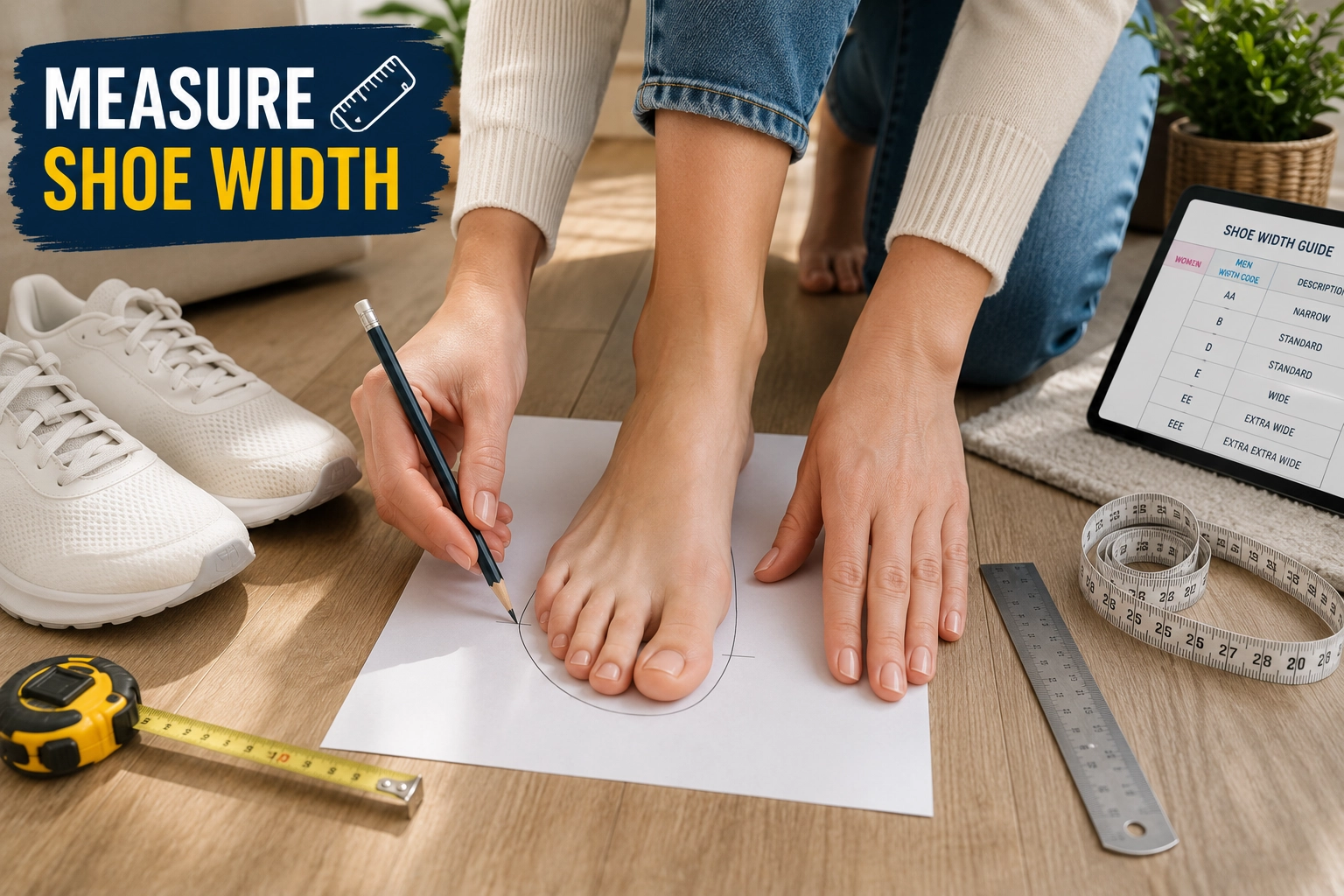
Most people focus only on shoe size and overlook shoe width, even though it plays a major role in comfort and fit. Ignoring your shoe width can lead to blisters, bunion pain, toe crowding, and other common foot problems. Learning how to measure shoe width at home takes only a few minutes, and knowing how to measure foot width at home can help you find the right shoe fit, choose more comfortable footwear, and make smarter shoe buying decisions every time.
Why Shoe Width Matters More Than Size
Most people do not realise that shoe size only tells you the length of your foot. Width is a completely separate measurement and it is the one that determines whether a shoe actually fits or just goes on your foot.
Most People Wear the Wrong Shoe Width
According to foot measurement studies, about 40% of people wear shoes with the wrong shoe width, which often leads to poor comfort and foot pain. Several common factors contribute to this problem:
Most shoes are available only in a standard medium width, and many brands do not clearly label the width on the shoe box.
- Many shoppers believe that choosing a larger shoe size will fix tight fitting shoes, but it only adds length not the extra width needed for a proper fit.
- Shoe width codes such as B, D, and 2E often confuse buyers because retailers rarely explain what they mean.
- Online shoe shopping also makes it harder to identify width issues since you cannot try the shoes on before buying.
The result is shoes that feel tight across the ball of the foot even at the correct length, repeated blisters in the same spots, toenails that bruise during long walks, and feet that spill over the edges of sandals and open shoes.
Benefits of the Right Shoe Width
Getting the right shoe width solves problems that a larger shoe size never can.
- No more pressure or pinching across the ball of the foot
- Toes lie flat without crowding or curling
- Heel sits securely without slipping
- Significantly reduced blister risk on the sides and top of the foot
- Better arch support and walking comfort over long distances
- Reduced long term risk of bunions, hammertoes, and nerve pain from chronic compression
Shoe Width Codes (A, B, D, EE & More)
Shoe width uses a letter based sizing system, and understanding what shoe width letters mean is important because the same code can represent different fits for men’s and women’s shoes. This is one of the most common reasons people choose the wrong shoe width, especially when shopping online.
| Width Code | Women’s Fit | Men’s Fit |
| 4A (AAAA) | Extra Narrow | Ultra Narrow (rare) |
| 2A (AA) | Narrow | Extra Narrow |
| A | Narrow | Extra Narrow |
| B | Standard Medium | Narrow |
| C | Medium to Wide | Narrow |
| D | Wide | Standard Medium |
| E | Extra Wide | Wide |
| 2E (EE) | XX Wide | Extra Wide |
| 4E (EEEE) | XXX Wide | Ultra Wide |
Key rules to remember:
- For women’s shoes, B is the standard medium shoe width and is the default width in most styles.
- For men’s shoes, D is the standard medium shoe width and is the default option for most brands.
- If a shoe box does not list a shoe width, it usually indicates the standard medium width for that gender.
- Width increments are not identical across every brand, so use the manufacturer’s own width chart whenever one is available.
- Shoe width letters are gender specific, so always use the correct men’s or women’s shoe width chart when choosing your fit.
What You Need to Measure at Home
No special equipment needed just gather these simple items before you start:
- A blank piece of paper (A4 or larger)
- A pencil or pen
- A ruler or flexible tape measure
- Socks you normally wear with shoes
Step by Step: Find Your Shoe Width
Don’t know your foot width yet? Follow this step by step guide on how to measure foot width accurately at home and find the shoe width that fits you best.
Step 1: Prepare Your Paper and Timing
Place the paper on a hard, flat surface and measure your feet at the end of the day when they are slightly larger due to natural swelling. Measuring in the morning can give a smaller reading, which may result in shoes feeling too tight later.
Step 2: Stand and Trace Your Foot
Stand on the paper with your full body weight on one foot. Avoid sitting, as it can reduce your foot spread and affect accuracy. Keep the pen straight up and down while tracing around your foot to create an accurate outline.
Step 3: Mark the Widest Points
Check your foot outline and identify the widest area, usually around the ball of your foot just below the toes. Mark the outermost points on both sides of the tracing.
Step 4: Measure Between the Marks
Use a ruler to measure the straight distance between the two marked points in inches. This measurement represents your foot width and gives you the number you need to measure foot width for shoes accurately.
Step 5: Measure Both Feet
Trace and measure both feet because one foot is often slightly wider than the other. Choose shoes based on your larger foot to ensure a more comfortable and proper fit.
How to Measure Shoe Width Without Tracing
If you do not want to trace your foot, you can measure shoe width with a ruler or flexible tape measure. Stand naturally with your full weight on the foot and measure across the widest part of the forefoot, usually around the ball of the foot. Measure both feet and use the wider measurement when comparing shoes. This method is quicker, but tracing gives you a clearer outline when you are measuring at home for the first time.
Shoe Width Chart: Find Your Width
Match your foot width measurement (in inches) to the chart below. Find your shoe size in the left column, then read across to find your width code.
Women’s Shoe Width Chart (Inches)
| Shoe Size | Narrow (A) | Medium (B) | Wide (D) | Extra Wide (2E) |
| US 6 | Under 3.30″ | 3.30″ to 3.55″ | 3.55″ to 3.75″ | Over 3.75″ |
| US 7 | Under 3.40″ | 3.40″ to 3.65″ | 3.65″ to 3.85″ | Over 3.85″ |
| US 8 | Under 3.50″ | 3.50″ to 3.75″ | 3.75″ to 3.95″ | Over 3.95″ |
| US 9 | Under 3.60″ | 3.60″ to 3.85″ | 3.85″ to 4.05″ | Over 4.05″ |
| US 10 | Under 3.70″ | 3.70″ to 3.95″ | 3.95″ to 4.15″ | Over 4.15″ |
Men’s Shoe Width Chart (Inches)
| Shoe Size | Narrow (B) | Medium (D) | Wide (E) | Extra Wide (2E) |
| US 8 | Under 3.60″ | 3.60″ to 3.90″ | 3.90″ to 4.10″ | Over 4.10″ |
| US 9 | Under 3.70″ | 3.70″ to 4.00″ | 4.00″ to 4.20″ | Over 4.20″ |
| US 10 | Under 3.80″ | 3.80″ to 4.10″ | 4.10″ to 4.30″ | Over 4.30″ |
| US 11 | Under 3.90″ | 3.90″ to 4.20″ | 4.20″ to 4.40″ | Over 4.40″ |
| US 12 | Under 4.00″ | 4.00″ to 4.30″ | 4.30″ to 4.50″ | Over 4.50″ |
Remember: Width standards may vary slightly between brands, so always check the manufacturer’s size guide before buying.
Shoe Width vs Shoe Size: What Is the Difference?
These are two completely separate measurements that work together:
- Shoe size (the number) measures the length of your foot from heel to toe
- Shoe width (the letter) measures the girth of your foot at its widest point
Going up a shoe size only adds extra length, not width. If your shoes feel tight around the ball of your foot but the length feels right, you need a wider shoe width, not a bigger size.
Since most shoes come in standard medium widths, choosing the correct width code is important for better comfort, proper fit, and healthier feet.
Common Fit Mistakes to Avoid
- Measuring while sitting: Sitting reduces foot spread and can give a narrower, inaccurate width measurement.
- Measuring in the morning: Feet are usually at their smallest early in the day, which can affect accuracy.
- Measuring only one foot: Most people have slightly different foot sizes, so always measure both feet.
- Choosing a larger size instead of a wider width: Extra length cannot fix a shoe width problem.
- Ignoring the width code: A shoe without a width marking usually means standard medium width, not a one size fits all option.
- Assuming all brands fit the same: Shoe widths can vary between brands and models, so check the brand’s specific sizing chart when possible.
Final Verdict
Learning how to measure shoe width at home is one of the most practical things you can do for your foot comfort. The process takes only a few minutes and requires no special equipment beyond paper and a ruler, and permanently improves the way you shop for shoes. Find your width, match it to the chart, and stop accepting shoes that are slightly wrong. The right width changes how every pair feels.
FAQs
Q1. What is the standard shoe width?
Ans. For women, B is the standard medium shoe width, while D is the standard medium width for men. If a shoe box does not show a width code, it usually means the shoe comes in the standard medium width for that gender.
Q2. How do I know if I need wide shoes?
Ans. If you are wondering how to know if you need wide shoes, check whether your shoes feel tight around the ball of your foot despite having the correct length. Feet that spill over the sides or frequent blisters in the same areas can also indicate that you need a wider width.
Q3. Can I use a Brannock device at home?
Ans. Yes, it measures foot length and width accurately, but a paper tracing method is also reliable for everyday shoe shopping.
Q4. Does shoe width change with age?
Ans. Yes, foot width can increase with age due to changes like ligament loosening and arch flattening. Pregnancy can also cause a permanent increase in foot width, so it is helpful to recheck your measurements if your shoes start feeling tighter over time.
Reviewed by Rachel Lee, Footwear & Style Reviewer at Candid Discoveries